Friday, July 18, 2014

Out the door

Whenever I'm trying to explain to another person why I like running, I tend to appeal to the freedom and the simplicity; I can run anytime, anywhere, and all I need is a pair of shoes. I don't need to depend on anyone else, or the appropriate facilities, or even the weather. I can just head out the door whenever I'm ready and go.


All of which just makes it that much more ridiculous that I'll be getting out of a perfectly good bed at 4:00 tomorrow morning, and hauling all this stuff to Carson City, Nevada for a run that I've been planning for the last seven months.

See you soon, with a race report!

Thursday, July 17, 2014

Range of Light

Spent some time in the Sierra Nevada with Petya today (her first time!) above 8000 feet, trying to get acclimated before the Tahoe Rim Trail 50M this weekend.

 
We took the tram at Squaw Valley up into the mountains, as I'm trying to keep my legs fresh for the race on Saturday. After ascending 2000 feet in eight minutes, we were able to walk around on some pretty flat trails with spectacular views of Lake Tahoe and the surrounding mountains. In the picture below, you're looking at very early sections of the Western States 100 course.


Of course we decided to do a little bit of climbing anyway, to reach views like these:


We sat at the base of these rocks and soaked in the views until the weather started to turn really quickly. We scrambled back down to the tram, only to find out that the thunderstorms rolling in had shut it down...possibly for the night!


Eventually the tram got going again, long enough at least to get all the stranded passengers back down the hill, while we all tried our best not to look at the ground 500 feet below. The bad weather did make for some pretty amazing light.


But if you know anyone with any influence on the weather, please put a word in for some sunnier skies; I've got a race to run, and Petya needs to work on her Tahoe face.


Friday, June 27, 2014

Of Runners and Writers

This recent piece on the parallels between running and writing has been getting a lot of praise in my online circles recently, and deservedly so. In spite of the fact that I know a lot of academics/writers who have been drawn to running--and often at precisely those moments when their writing practice becomes most difficult or intense--I also have the sense that most of us cannot clearly articulate the link between the two activities, and often feel at pains to defend our running habits against the perception that they are distracting from our real work. My own experience of the disconnect between the two nearly led me to abandon running early on. I would justify the time I spent running by telling myself that getting away from the computer was just what my mind needed to work through that piece of the argument that wasn't quite clicking; what I found, though, was that running (usually) made my mind go completely still, sending me into a kind of objectless focus that's probably perfect for Zen meditation, but less so for carving out one's niche within a contentious field of scholarship. What's worse, I found that I even liked this effect, began to crave it, secretly ran in order to get back to it. It had to stop.

But what I noticed was that the effect of this "distraction" was precisely the opposite of what I would have expected. I wrote more clearly. I wrote with less hesitation. I wrote right through problems, picking them apart one step at a time, rather than skirting them, or dismissing them, or skipping of to check my email in the face of them. I even began to write with greater pleasure. Maybe that's why lines like these rang so true for me:

"Running has made me a more disciplined writer, and writing has reminded me to be brave when racing. I’ve learned—I’m trying to learn—to keep faith in the face of flagging mind, body, spirit, and confidence. I know that any valuable achievement will require that I make myself uncomfortable and may well hurt. I’ve learned to recognize the pain: 'Here we are again. This is the part that sucks. This is the place where I want to give up.'"

And that, contrary to what the headline suggests, strikes me as the crucial insight of this essay--not that running and writing merely have something in common, but that each practice promotes and solidifies the other. Will running make me a better writer? Only in the sense that "done is better than perfect," a lesson every runner must be reconciled with (nobody wins every race!). Will writing make me a better runner? Only in the sense that the road to improvement runs directly through miserable failure, something that every writer re-learns daily. But neither of those lessons is inconsiderable. Running is a much more mental activity than non-runners could ever hope to understand, and writing is a far more bodily enterprise than our cliches of the writer as disembodied recluse, fueled only by intellectual passion (and perhaps alcohol) will ever let on. Computers may be able to string words together into coherent sentences, but only a body can write.

All of that said, I can't get around the fact that my gut reaction to the essay's main contention consists of two seemingly incompatible responses: "Not really," and "Duh." Let me see if I can explain. (to be continued!)

Tuesday, July 16, 2013

Full Moon 50K


Right now in Perry, Arkansas, it is 90 degrees outside, at 8:00pm. That’s down a bit from the afternoon high of 95. Meanwhile, the forecast for New York tomorrow is 94 and nobody can shut up about the “sweltering heat wave.” In Arkansas in the summer, that’s just called “Tuesday.”

In any case, the reason for my sudden interest in Arkansas weather is the Full Moon 50K, which I’ll be running in Perry, Arkansas, this Saturday, at 8:00pm. The forecast high for Saturday is 95 again. Forecasts are seldom very accurate more than a couple of days out, but at this point I think I can count on it being hot. Seems obvious now, but I actually chose this race in the hope of “avoiding the heat.” The problem is, the only way to avoid the heat in Memphis in the summer is to stay inside. Given the state of the trails this time of year apart from the weather—nettles, poison ivy, mosquitoes, snakes—I definitely gave that option some thought. But given that I have long races coming up in October and December, it isn’t a very good option for me.

So apart from taking the summer off, the only way to avoid the heat is to run at night. It's called the Full Moon because it's run at night, in the light of the (mostly) full moon, on a pretty runnable course. From what I hear, it's the kind of race that people either PR or overheat and drop out. Sounds kind of fun, except that I pretty much wilt in the heat. Obviously staying hydrated is key in a race like this, especially for someone like me who sweats up to 4 or 5 pounds of water per hour in the heat. And the good news is that water stations are only about 4 miles apart on the course, so I won't need to carry more than I can drink in about 30-40 minutes. Still, I'm more than a little nervous about the heat. I'll be carrying water, electrolytes, and gels, but I'm looking for your advice for staying cool--or at least just keeping moving in the heat. Comment away!

Also, if you read about Four on the Fourth and wanted to see photographic evidence, it is now up (finally).

Thursday, July 4, 2013

Four on the Fourth

Back when I was whatever age you are when you start losing your teeth--baby teeth, I should say, as that other age is still ahead of me--I accomplished a pretty remarkable feat that has since been celebrated in Grady family history. Not continuously, mind you, as I did not reveal my accomplishment to the world until about a decade later, when at last I no longer feared the repercussions of sharing my secret triumph with well-meaning but over-protective parents who, let's be honest, lack the stomach for danger that is requisite to a genuine appreciation of heroism. OK, heroism on a fairly minor scale, in this case. Maybe "highly unusual deeds" would be more accurate, but definitely that. Probably even "deeds never before performed, at least in this school district by someone who has seen The Empire Strikes Back four times.

So it was the Fourth of July. My family was having a small backyard party, which right off the bat gives this story an air of fantasy, since my family was not exactly known for hosting parties, but it's true. Like any kid, all I could think about was fireworks. My parents are even less known as blowing-stuff-up types than as hosters of parties, so our personal stash of "explosives" was admittedly a fairly modest haul. Still, we had more sparklers than you could shake one of those incense-like firework lighting things my dad always called a "punk" at, and a whole bunch of those little black pellets that would glow into little shrivelled "snakes" of ash and gas the whole neighborhood with noxious fumes. Not to mention those flower things that spin on the ground and change colors, a smoking log cabin, one of those ones that you nail to the wall and it spins around and shoots out sparks, and the coup de grace: a Piccolo Pete. If you don't know what that is, congratulations, you probably still have the ability to hear an actual piccolo.

Like I said, a fairly modest haul, but still, those fireworks were all I could think about. That, and my loose tooth--cuspid, top row, tooth-loser's left. It had already been loose for a couple of days, so I figured it had to be ready to come out. The tooth fairy had been pretty good to me when I pawned my two front teeth for cash, and the prospect of making a deal with a tooth fairy who just might have some leftover fireworks--c'mon, c'mon, just some bottle rockets or a roman candle--had me feeling pretty giddy. I had to get that tooth out while it was still the Fourth of July, and that meant finishing the deed before the guests arrived. I got right to work.

A little hard work and determination saw that tooth out in no time, with hours to spare before it would be dark enough for fireworks. As I contemplated how to pass the idle time, a lesson learned from losing my two from teeth suddenly occured to me: there's another one just like it on the other side!

By now you can surely see where this is going, so I'll spare you the gory details of the twisting, the tugging, the string around the tooth tied to the doorknob (that doesn't work); sorry, I said I'd spare you the details. The crucial moment came when it dawned on me, somewhere after I managed to wedge my tongue in underneath number two, that in fact I had four canines, and if one was ready to go then the other three almost certainly would be as well. Dogs do everything in groups.

For those still disinclined to believe that I lost four on the Fourth, I assure that visual evidence exists. (edit: Yep, here it is!)


Somewhere among the family photo albums (Ellie, do you have a copy?) there is a picture of my from later that night, watermelon stains on my Izod polo, sparkler held proudly aloft, and me screaming in delight as I reveal four gaping holes in my toothy grin. Honestly, I don't know how they didn't notice. They must have been distracted by my awesome, side-parted bowl cut.

Anyway, I bring this up for a reason, and I swear it's actually running related. Never one to miss an opportunity to commemorate the occasion, Petya asked me this morning how we would celebrate this year. "What should we do four on the Fourth of?" she asked. When I suggested we could run four miles she laughed, then agreed. "Starting next year, we run four miles together every Fourth of July," she said, pausing for a moment before adding, "But if we're in Europe we run four kilometers." So just like that, another Grady family tradition is born.

Happy Fourth of July to you and your family, and may you only lose four of something you were looking to get rid of anyway.

Thursday, June 27, 2013

Dipsea: Part 3 (Dipsea 2013 race report)

Shortly after passing the 1-mile marker, the course emerges onto Panoramic Highway--the road that roughly parallels the race course, connecting Mill Valley to Stinson Beach by going up and over the side of Mt. Tamalpais, as opposed to the more popular Route 1, which skirts the mountain by hugging the coastline north from Muir Beach. This is a welcome development for two reasons: first, it means that a much-needed downhill section is coming, and second, it means you get the first of the many spectacular views that, at this point, are well-earned.
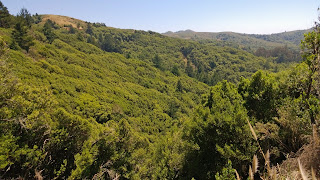
 

Pretty nice, right? This is the view if you're facing more or less in the direction of the finish. Behind you are views back down the stairs and into Mill Valley, and beyond that countless Marin County homes clinging to the sides of golden, sunlit hills that plunge into the misty waters of San Francisco Bay. But there was no time to look at that now. Those dark, gently sloping woods ahead were too inviting, and I had too much ground to make up. My plan had been to survive the stairs and make up ground on the downhill; that meant there would be no time to enjoy the view. And besides, this wasn't really what I saw. See, this picture was taken two days before the race, on a hot (at least by Northern California standards) and sunny day, but race day was cool and drizzly, with low cloud cover, and fog blowing off the ocean and through the meadows of Mt. Tam. The view I saw was more like this:


Probably a good thing, since I had no business looking anywhere but the trail under my feet. Crossing Panoramic Highway, the course gets right back onto single-track. There's really only about a quarter-mile of downhill trail here, but it's decently steep--about half stairs--and fairly wide, which made for easy passing. Just as soon as I was getting settled into as decent a pace as I could maintain on some hard-packed, rolling downhill, it was right back onto the road, this time for almost half a mile. With a gentle downhill slope and two lanes of pavement, this was another great section for moving up in the pack. I felt pretty good about the progress I was making at this point, but knew I had a lot more people to catch, and was eager to get back on the trail. More than that, though, I was eager to through the next section of the course, and the harrowing decision that lay ahead.

Until recently, I had never seen the entirety of the Dipsea course, only the section between Stinson and Muir Woods. Granted this is about 5.5 of the roughly 7.4-miles, but it leaves out a couple of infamous portions of the trail: the stairs, and a marked shortcut forbiddingly named "Suicide." Knowing that I would arrive in California three days ahead of the (Sunday) race, I had originally meant to run the course on the Thursday before. That would give me a chance to see the full course, to check out some of the shortcuts, and to establish a rough sense of how I'd need to pace myself to meet my goal of 1:10. But when a delayed flight out of Memphis led to a missed connection in Minneapolis, I arrived a day late and had to cancel my Thursday run. Not wanting to race on only a day's rest (normally this wouldn't be a problem, but it's a pretty tough course), I decided just to go walk the sections I hadn't seen before on Friday. I even wore jeans and left my running shoes at home, knowing that once I was on the trail the urge to run would be close to irresistible.

One thing I've learned in my short time running trails is that people love to get each other (and themselves) worked up about certain notorious sections of trail. The first time I ran the "red" loop in Memphis's Shelby Forest, I half expected to find that it was so named for all of the blood it had claimed from unsuspecting runners; and when I was getting ready to run the Sylamore 25K in Arkansas's Ozark Mountains last February, I spent more time worrying about the much-discussed river crossing than the rest of the course. Things are usually not half as bad as they're made to sound, and you can pretty much be sure that's true when you're told that a section of trail is "suicide." Nonetheless, I wanted to see for myself, if only to compare the shortcut to the other portion of trail, and decide which I'd opt for on race day. Once I've seen it, I thought, I'll know which way to go.

Starting down the shortcut means pushing aside some brush, as this section of trail probably doesn't see a lot of use outside of race day. Not being able to see what's ahead certainly heightens the drama, but there doesn't seem to be much risk of bodily harm, apart from some possible minor scratches, after about 100 feet, though, the trail widens and becomes noticeably steeper. Hard-packed and covered in gravelly dust, it begins to feel less like a trail and more like a small section of hillside too steep for roots to take hold. Walking down this in my street clothes, I began to feel a bit of apprehension, but decided to scramble my way down anyway; it was only about 30 feet or so until the trail flattened out and...WHOOOOSH...POP! I couldn't tell what was causing the rush of sensation coursing through my veins, the pain in my knee or the embarrassment of having been stupid enough to injure myself two days before the race. Faster than I could see it happening, I slipped awkwardly on the loose dirt, and felt a sharp pain in my knee. I'm not really sure how it happened, as I was back up on my feet before I even felt anything, but my knee was sore in a way that I'd never experienced before. For a few minutes, I thought I was done.

Fortunately my knee was feeling fine on Sunday morning, but my anxiety about Suicide was at an all-time high. Sure, I could take the main trail and play it safe, but as I'd seen on my way back up the trail two days earlier, it was also less direct. As I turned off the road and headed to the fork on race day, I still hadn't made up my mind which way I'd go. Maybe it was the fact that the light drizzle had added a little bit of traction to the otherwise dusty trail, maybe it was the voice in my head that kept repeating something I'd read--"all the fastest runners take Suicide"--but either way I quickly found myself pushing aside the brush and falling in line with a train of runners who, like I had two days earlier, wondered aloud why this rather timid section of trail was given such a daunting name. "It gets worse farther down," I yelled, and watched as they slowed down, leaving me room to slide uneventfully by, joining back up with the main trail, and scrambling down the hill into Muir Woods.

Muir Woods is a magical place, home to massive redwoods and to equally over-sized banana slugs, and if you ever find yourself there you absolutely must drop whatever you're doing and go for a leisurely hike on its shaded trails. Unless, of course, what you're doing is running a race. dashing through the parking lot, we dropped down to the course's lone creek crossing--about 40 feet wide and spanned by a narrow wooden plank. I paused for a split second in disbelief as a crowd of people lined up to shuffle single-file across the bridge, then shot straight through the creek, whose water didn't even reach my ankles. Pro tip: running shoes dry out.

At this point I was feeling pretty good. I had passed people, as needed, at every reasonable opportunity, had put the most nerve-wracking obstacle (the stairs) behind me, and knew I had some beautiful trail ahead. Plus, I felt like I'd gone pretty far and still had plenty left in the tank. Then I did some quick math, and remembered I'd only gone two miles! Maybe it's because the terrain varies so quickly, that you get the impression of having traveled more distance than you have; whatever it was, that feeling was about to change. Ahead of me were just over two miles of steady uphill, with over 1000 vertical feet to climb. Now don't get me wrong, that's exactly what I was here for. On most weekends, that's my idea of a good time. If doing it once doesn't run me into the ground, I'll turn around and do it again, and again, until it stops being fun. At race pace, though, the thought was mildly nauseating. I decided to put the thought out of my head, focus on the lush, ferny switchbacks of the hill called Dynamite, and keep my head down.

One of the keys to running steep hills, I've found, is to simply keep moving, the more smoothly the better. Small, quick, even steps are preferable to longer, lurching strides. The idea is simply to keep whatever modest measure of momentum you have, and let your body glide up the hill. No such grace was granted to me this day. This was a slog. Every time I did manage to get some rhythm going, the trail got too steep, or turned too hard, or I simply succumbed to the log-jam of runners all suffering the same fate. Yes, I was keeping my head down, but that just meant the sweat pouring off my head was all ending up in my eyes. Still, I kept my head down. This too shall pass. I kept my head down, watching my feet, for what felt like hours, until I heard a gasp on the trail ahead of me. Then another. I looked up and saw sheet of bright red looming ahead of me: poison oak, my oxygen-depleted brain registered. Except it was full of pale, whitish patches, and it was moving, coming straight down the hill toward me. Blinking the sweat out of my eyes, I took another look and saw a runner, tall and slender, working has way against the stream of runners, with streaks of blood running from the top of his head right into his shoes, covering the majority of the front half of his body. "I'm fine!" You could tell he was getting as tired of having to convince horrified onlookers of that fact as he was bummed that his race was over. All that looking down mixed with low-hanging branches is a dangerous combination, and cuts on the head always bleed profusely. I heard he ended up being fine, but I also know he wasn't the only runner to leave more than a little blood on the course. That said, my at goes off to the excellent first aid workers who were actually out on the course helping injured runners, as well as the rest of the volunteer workers who kept an event that had every right to turn into total chaos working like a smooth, efficient machine.

After the woodsy switchbacks of Dynamite, you emerge into a clearing; the trail straightens out, but continues steadily uphill through a section called Hogsback. It is here, on the left side of the trail as you pass under the power lines, that you'll find Halfway Rock, so named not because it's actually halfway in distance, but because it marks the halfway point on the clock for many runners. At least that's the idea. I dared to look down at my watch and got my first real sense of how realistic my goal of 1:10 had been--31:30! Much as I fought them off, visions of a 1:05 finish danced into my head. That probably doesn't sound like much of a difference, but it felt like the difference between near certain qualification and having to bite my nails for a few days while they sorted out the final results. Still, I told myself, "halfway" is obviously an approximation. Nobody dragged this rock up here years ago so that it could one day mark the halfway point in your race that nobody but you cares about. Head down, keep climbing.

I wasn't so much sick of climbing at this point as I was eager to get to even some modest downhill. I know that sounds like the same thing, but I actually like climbing--just not for so long. One problem with training in Memphis is that we just don't have any sustained hills. Steep hills we have, if you know where to find them, and with enough reps you can pack plenty of climbing into a workout, but you're always going to get plenty of downhill "rest" mixed in. I longed for a little dip in the trail, just enough to build some momentum that I could carry into the next climb. I found myself walking a couple of times, to keep from getting on the wrong side of exhaustion--not a problem on a longer race, but definitely not in the game plan for a seven-miler. In any case, my fitness level was obviously not where I had thought it was, and I felt tremendous relief when I spotted the top of Cardiac Hill, the highest point in the course. From here, it would be (almost) all downhill.

The three-mile descent to the sea begins gently, sloping through wooded sections of trail that, for the first time on the course, are exposed to the soggy Pacific breezes. If you're familiar with the micro-climates of the Bay Area, you know what a profound difference a few crucial feet can make, and things were decidedly more muddy here. Watching people tiptoe through and dance around the sloppier portions, I realized that whatever Memphis (or my own want of training) had cost me on the long climb, it was helping me gain back in the mud! When your entire city lies within 100 vertical feet of the Mississippi River, you get used to running through mud or you don't run trails. You also get used to charging downhill with slippery footing, sliding if you have to, so long as you stay on your feet and keep moving. The confidence that that builds definitely cam in handy as the trail fell away to the coastline, dipping down the wet, mossy steps of Steep Ravine. Before you get there, though, you reach another optional shortcut, known as the Swoop. I didn't know where it was, but somehow I ended up on it, and found it to be aptly named. I hesitate to call what I did here running. It felt more like being a runaway mine car--not like being in one, but being one. The trail was so narrow, so overgrown, that you had no choice to make about where to direct each step. Invariably, the answer was "right there," straight down the trail, and hopefully not long enough to feel the ground, or your momentum will take you right over the handlebars and deposit you in the brush.

And that's about all I remember, until I popped out onto the highway yet again, shot down some more steps through the woods, and popped out over the turnstile that sits a few feet above Highway 1, just a stone's throw from the finish line. At least if you're, you know, someone who's really good at throwing stones. Heading into Stinson with the ocean on your left side, you make a sharp left turn near the fire station and head straight to the finish line. I knew because, despite never having done the race before, I'd studied the turn-by-turn description of the course, with photos, on the Dipsea website, and because I could see the crowd of people waiting there, about 300 yards in front of me. I kicked it into the closest thing I had left that resembled top speed, and even managed to catch a couple more runners in front of me, just in case. I would finish strong, feeling good, and having left it all on the course. And then I heard a voice in my head: "take the second left turn, immediately after the first, onto Arenal Avenue, to reach the beach...on the private road, you'll turn left right after the gate." NOOOOOOOOOOOOOO! That was not the finish. one more left turn, and another 300 yards were still ahead of me, and I was done. Done. I am not a good sprinter, and I had already been sprinting for longer than I could maintain. I rounded the bend and saw the expectant crowd in front of me, kindly cheering just as loud as if we were the first runners coming in, and it was then that I knew I would need to walk. Across. The. Finish. Line.

One of the runners I had just passed, a third of my age, passed me right back. Ouch. But I didn't walk. I made ghastly sounds and hideous, contorted faces, to be sure, but I struggled my way across the line in a fashion that would have disqualified me from a speedwalking competition, a minor victory in itself. I tried to give myself a moment to bask in the feeling of accomplishment, the joy of the pure run, the spectacle of natural beauty all around me, but I couldn't resist the temptation to compromise all of that by turning it back into a race and looking at my watch. 1:04. Six minutes better than I had hoped for, one minute better than I had thought possible for me, and good enough to earn me my very own finisher's medal!


It was also good enough for 617th place, which means I qualify to run again next year. Post-race, it was back to Mill Valley to meet up with my dad, sister, and brother-in-law for lunch, the perfect end to a perfect race. Big thanks to everyone who makes this event possible, to all those who have contributed to its storied history, to my dad for helping me secure a spot, and to Ellie and Jon for putting up with my neurotic behavior in the final days before the race!

Run this race if you get a chance. If you don't, there's also a Double Dipsea and a Quad Dipsea. Or just go run the course. If you're doing to see the whole course without going to California, and have a high tolerance for unsteady-cam, you can check out this video made by one of this year's runners. Next up for me is the Full Moon 50K, a moonlight trail run in Arkansas in July. It promises to be hot, and dark. Duh. I'll keep you posted.


Friday, June 21, 2013

Dipsea: Part 2 (Dipsea 2013 race report)

This time of year, the poison oak in Northern California starts to turn bright red, warning of its presence even to those who failed to earn their Plant Science merit badge. Botanically inept as I am, I welcome this development, scanning the dark green forest backdrop for flashes of red on my runs through the woods, too focused on where my feet are landing to count leaves on the fly. But just because you're warned doesn't mean you aren't still going to get it.

Coming into this year's Dipsea race, I had three goals: 1) finish with a fast enough time to qualify for next year's race; 2) manage to enjoy myself in the process; and 3) avoid the poison oak. It quickly became clear that these were incompatible goals, and one or more of them would have to go. 2 suffered an uneven fate during the course of the race; though clearly dependent to some extent on 1 and 3, it was generally more closely linked to the burning in my legs. The simplest way to measure 2 would probably be to take the elevation profile of the course:


And rotate it 180 degrees. Here you go:


The conflict, really, was between 1 and 3, qualification and avoiding poison oak. Here's why. To qualify  automatically for Dipsea 2014, and avoid the vicissitudes of the application process, I would need to finish in the top 750 spots. Considering that about 1800 would line up at the start (among whom, surely, there would be some non-finishers), that didn't sound like such a difficult task. But that's where the head-start format of the race comes into play. Not only is the race handicapped for age and gender, but runners are then further separated into invitational and "open" groups, with the invitational runners going first and on the same clock. What all of this meant for me is that I would be starting the race a full 50 minutes after the first runners, and 27 minutes after the invitational runners in my age group. The last runners in the invitational group would leave 25 minutes ahead of me, meaning there would be over 700 runners with a shot at being halfway to the finish line before I even started, and nearly 1,000 more with smaller head starts. No runner in the "open" section of the race has ever finished higher than 446, in a year when there were only 934 finishers. Basically, to finish in the top 750 I would need to pass about 1,000 runners on the course. On single-track. Cue poison oak. Once I did the math, I decided to give in to poison oak, and focus instead on all of those people starting in front of me.

The start of the Dipsea is as much a celebration of the race's history and its quirkiness as it is the beginning of a race. I had planned to be there early enough to watch the first runners leave at 8:30, but my race-day nerves made sure of it, as I was out of bed and on my way from my sister's house in San Francisco (about a 25-minute drive) before 6:00. Perfect, just enough time to get there early and let my anxiety build up! Fortunately, the starting line offered plenty of entertainment including watching 8-year-old girls and boys line up alongside the likes of last year's winner, 73-year-old Hans Schmid, and then take off at a full sprint with the gun. Before I knew it, it was time to line up in the corral and let the adrenaline really start to build.

Watching your competition depart with the punctual efficiency of German trains leaving the station has a strangely calming effect. It's as if your own start is an inevitability, ineluctable as time itself, rather than something to be fretted over. Or so it seemed, anyway, until I was lining up with the rest of my heat, still about two groups (and thus two minutes) behind the starting line. That's when it hit me: I hadn't avoided pre-race anxiety, I had simply deferred its arrival, and now it was making up for lost time. I tied my shoelaces too tightly. Should I have left my shirt in the car? Too late, I don't have time to re-pin my number to my shorts. 690 steps, right? Or was it 670? Maybe I should have had a gel without caffeine. And why is this guy standing right up in my face? Maybe I know him. No, definitely not, but he must think I know him. Smile. No, don't grimace, smile. Shit, when did we start running?

The first half mile of the course takes you over paved roads, across "downtown" Mill Valley, through a small park, and then up what looks like a short, steep driveway. Just as this hill starts to take the spring out of your step, you arrive at the bottom of the stairs: 3 flights, 680 steps, equal in height to a 50-story building. That's the first part of the race that I have any recollection of, since my head was just buzzing until then. Starting races always feels a little like an out-of-body experience for me, and when left to its own devices my body apparently has a tendency to try to keep up with the fastest thing around me. Today was no exception, and I would up hitting the stairs already a little winded. No problem, though, I had put in some time training on stairs. Lots, actually. In fact, everything about my race-day preparation had been going as planned until I looked at my calendar and realized that I would be in Berlin--flat as a pancake, bicyclist's paradise Berlin--three weeks before the race. OK, I realize that "training" for a seven-mile race is pretty ridiculous, even one on as demanding a course as this. If you're not already in shape to run seven miles when you sign up, then your probably have no business taking the spot from someone else. But I didn't just want to finish, I wanted (pretty desperately) to have the chance to do it again next year, and that meant qualifying. If past years were any indication, that meant I would probably have to run about 1:14, maybe 1:12. I was aiming for 1:10, just to be safe. That meant I would need to find some hills in one of the flattest parts of the world.

During the last ice age, when glaciers and streams flowing north out of the Alps deposited Berlin atop the vast North European Plain, they set it among vast expanses of woodland and lakes, but they did not see fit to give it any mountains. History, however, completed the work that geology left unfinished; rubble left behind after the destruction of the city during WWII was collected and piled up in several locations around the perimeter of Berlin, creating makeshift mountains and turning tragedy into "natural" beauty. Today, these mountains are completely overgrown with forests, and only reveal their back-story upon close inspection. One such mountain, located within the vast network of wooded trails that make up Berlin's Grunewald, is Teufelsberg ("Devil's Mountain")--aptly named not only for its origins, but also for what it doles out to those who take too direct an approach at its admittedly modest 350 feet. The mountain is so carved up with trails and stairs that you can reach the summit at virtually any grade you like, starting from near flat and going all the way up to too steep to run. This is where I tested my legs in the peak days of my Dipsea preparation, and I was feeling pretty good. Bring on the stairs!

I settled right into a pretty good rhythm, taking the first few steps two at a time. I had just scouted the stairs two days earlier, and knew what was coming, so I planned to keep that up for about the first 200 (even, regularly-spaced, wooden stairs), then take the last few (steeper, and built from uneven, smooth stone) one at a time. Then I hit a wall of people. I don't know whether I was more frustrated that I had to walk, or relieved that I got to walk. There are sections of the stairs (the second flight) where you can scramble up the hill next to the steps, but this wasn't one of them, as the steps were penned in by tall handrails. Up to that point I had been able to steadily pass people--I wasn't counting, but I was gaining ground--but that quickly came to a halt as I was trapped in a swarm of sweaty, panting bodies. Not in a good way. That's not to say that the order wasn't changing, but just in a salmon swimming upstream way, more than a nice, orderly, cars passing in the left lane way. Elbows were flying, the chatter was getting intense, and it felt more like climbing over people than passing them, but I managed to keep pushing (politely) ahead, and soon emerged at the top of the first set. Sometimes it pays to be skinny and stubborn.

If you've made it this far, you've been plenty patient, so I won't bore you with detailed accounts of all three flights. But one more story from the stairs. Somewhere in the second flight I took advantage of the "trail" to the side of the steps, and broke ahead of the group I had been stuck in. Somewhere behind me I heard someone growl (I'm not saying that to add color, dude actually growled), "Don't let 'Memphis' out of your sight!" Now I'm not accustomed to answering to "Memphis"--I've only lived here for four years--but given the setting I was pretty sure he meant me. I was, after all, wearing a Breakaway singlet that says "Memphis" on the back, a word that he managed to pronounce with such audible sneer that I just had to 1) laugh; and 2) turn around to see who said it, in spite of the fact that I was scrambling up a steep, makeshift trail. Can you guess? Yep, it was that same guy who had been giving my the stink-eye back at the starting line! Some perspective, please. We are grown men, wearing shorts. We are running up stairs, when there's a perfectly serviceable road that goes to the same place. We both pay our taxes, and abstain from torturing puppies (I presume). We are decent people, doing something intrinsically goofy, for fun. But don't let that stop you from taking it really seriously, and getting all silverback and territorial on me. Don't let that stop you from acting like you're auditioning for a part as an extra in Point Break. Loser. For the record, he did let me out of his sight, unless he has eyes on the back of his head. Dude beat me by a full two minutes, and good for him. Yeah, I looked it up. Loser.

When you reach the top of the stairs, you hit a short stretch of paved highway, and it feels like running on a trampoline; but the emphasis here is on the word "short." Another hundred yards, and you're climbing again, steep enough that you miss the stairs. What does it feel like not to be climbing? I can't remember. All I remember is climbing, I must have been climbing for...oh, there's the one-mile marker. (OK, it's Friday afternoon and I need to go run...to be continued)